The Following Alcohol Can Be Synthesized Two Different Ways Utilizing
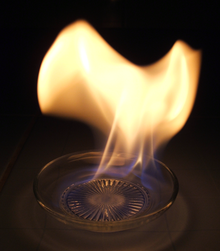
Diverse alcohols are used as fuel for internal combustion engines. The first four aliphatic alcohols (methanol, ethanol, propanol, and butanol) are of interest as fuels because they can be synthesized chemically or biologically, and they have characteristics which allow them to be used in internal combustion engines. The full general chemical formula for booze fuel is CnorthH2n+oneOH.
Most methanol is produced from natural gas, although it can be produced from biomass using very similar chemical processes. Ethanol is commonly produced from biological material through fermentation processes. Biobutanol has the reward in combustion engines in that its free energy density is closer to gasoline than the simpler alcohols (while all the same retaining over 25% college octane rating); however, biobutanol is currently more than difficult to produce than ethanol or methanol. When obtained from biological materials and/or biological processes, they are known equally bioalcohols (eastward.g. "bioethanol"). There is no chemic difference between biologically produced and chemically produced alcohols.
One advantage shared past the four major alcohol fuels is their high octane rating. This tends to increment their fuel efficiency and largely offsets the lower energy density of vehicular alcohol fuels (as compared to petrol/gasoline and diesel fuels), thus resulting in comparable "fuel economy" in terms of altitude per volume metrics, such equally kilometers per liter, or miles per gallon.
Methanol and ethanol [edit]
Methanol and ethanol can both be derived from fossil fuels, biomass, or perhaps nearly simply, from carbon dioxide and water. Ethanol has most commonly been produced through fermentation of sugars, and methanol has about commonly been produced from synthesis gas, but at that place are more than modern ways to obtain these fuels. Enzymes can be used instead of fermentation. Methanol is the simpler molecule, and ethanol tin can be made from methanol. Methanol can be produced industrially from nearly any biomass, including animal waste, or from carbon dioxide and water or steam past first converting the biomass to synthesis gas in a gasifier. It can as well be produced in a laboratory using electrolysis or enzymes.[1]
As a fuel, methanol and ethanol both take advantages and disadvantages over fuels such as petrol (gasoline) and diesel fuel fuel. In spark ignition engines, both alcohols tin can run at much higher exhaust gas recirculation rates and with higher compression ratios. Both alcohols accept a high octane rating, with ethanol at 109 RON (Enquiry Octane Number), 90 Monday (Motor Octane Number), (which equates to 99.five AKI) and methanol at 109 RON, 89 Mon (which equates to 99 AKI).[2] Note that AKI refers to 'Anti-Knock Index' which averages the RON and MON ratings (RON+MON)/2, and is used on U.S. gas station pumps. Ordinary European petrol is typically 95 RON, 85 MON, equal to 90 AKI. As a pinch ignition engine fuel, both alcohols create very few particulates, but their low cetane number means that an ignition add-on similar glycol must be mixed into the fuel at approx. 5%.
When used in spark ignition engines alcohols accept the potential to reduce NOx, CO, HC and particulates. A test with E85 fueled Chevrolet Luminas showed that NMHC[three] went down by 20-22%, NOx by 25-32% and CO by 12-24% compared to reformulated gasoline.[4] Toxic emissions of benzene and 1,3-butadiene also decreased while aldehyde emissions increased, (acetaldehyde in particular).
Tailpipe emissions of COii as well decrease due to the lower carbon-to-hydrogen ratio of these alcohols, and improved engine efficiency.
Methanol and ethanol fuels contain soluble and insoluble contaminants.[5] Halide ions, which are soluble contaminants, such every bit chloride ions, have a large effect on the corrosivity of booze fuels. Halide ions increment corrosion in two ways: they chemically attack passivating oxide films on several metals causing pitting corrosion, and they increment the conductivity of the fuel. Increased conductivity promotes electrical, galvanic and ordinary corrosion in the fuel system. Soluble contaminants such as aluminum hydroxide, itself a product of corrosion by halide ions, clog the fuel arrangement over time.
To prevent corrosion the fuel system must be fabricated of suitable materials, electric wires must be properly insulated and the fuel level sensor must be of pulse and concord type, magneto resistive or other similar not-contact blazon. In addition, high quality alcohol should have a depression concentration of contaminants and have a suitable corrosion inhibitor added. Scientific evidence reveals that h2o is an inhibitor for corrosion by ethanol.[6]
The experiments are washed with E50, which is more aggressive and speeds upwards the corrosion upshot. It is very clear that past increasing the amount of water in fuel ethanol i can reduce corrosion. At 2% or 20,000 ppm water in the ethanol fuel the corrosion stopped. In line with the observations in Japan, hydrous ethanol is known to be less corrosive than anhydrous ethanol. The reaction machinery is iii EtOH + Al -> Al(OEt)three + 3⁄2 Htwo at lower-mid blends. When enough water is nowadays in the fuel, aluminum will react preferably with water to produce Al2O3, repairing the protective aluminum oxide layer. The aluminum alkoxide does not make a tight oxide layer; water is essential to repair the holes in the oxide layer.
Methanol and ethanol are incompatible with some polymers. The alcohol reacts with the polymers causing swelling, and over time oxygen breaks down the carbon-carbon bonds in the polymer causing a reduction in tensile forcefulness. For the past few decades though, most cars have been designed to tolerate up to x% ethanol (E10) without problem. This includes both fuel system compatibility and lambda compensation[ clarification needed ] of fuel delivery with fuel injection engines featuring closed loop lambda control. In some engines ethanol may degrade some compositions of plastic or safety fuel commitment components designed for conventional petrol, and too be unable to lambda compensate the fuel properly.[ citation needed ]
"FlexFuel" vehicles take upgraded fuel arrangement and engine components which are designed for long life using E85 or M85, and the ECU tin can suit to whatever fuel alloy between gasoline and E85 or M85. Typical upgrades include modifications to: fuel tanks, fuel tank electrical wiring, fuel pumps, fuel filters, fuel lines, filler tubes, fuel level sensors, fuel injectors, seals, fuel rails, fuel pressure level regulators, valve seats and inlet valves. "Full Flex" autos destined for the Brazilian market can apply E100 (100% ethanol).[ citation needed ]
One liter of ethanol releases 21.1 MJ in combustion, a liter of methanol 15.viii MJ and a liter of gasoline approximately 32.6 MJ; the divergence is due to the different oxygen content.[7] In other words, for the aforementioned energy content every bit i liter or one gallon of gasoline, ane needs i.6 liters/gallons of ethanol and 2.1 liters/gallons of methanol. The raw free energy-per-volume numbers produce misleading fuel consumption numbers, however, because alcohol-fueled engines can be fabricated substantially more than energy-efficient. A larger percentage of the energy released by combustion of a liter of alcohol fuel can be converted to useful work. This difference in efficiency tin can partially or totally residue out the energy density difference,[ citation needed ] depending on the detail engines beingness compared.
Methanol fuel has been proposed equally a time to come biofuel, often every bit an alternative to the hydrogen economic system. Methanol has a long history as a racing fuel. Early on Grand Prix Racing used blended mixtures also as pure methanol. The fuel was primarily used in N America after the war.[ clarification needed ] However, methanol for racing purposes has largely been based on methanol produced from syngas derived from natural gas and therefore this methanol would non exist considered a biofuel. Methanol is a possible biofuel, however, when the syngas is derived from biomass.
In theory, methanol can also be produced from sustainably sourced biomass and ultimately carbon dioxide, and by hydrogen electrolysis using nuclear power, geothermal power or another renewable free energy source (run into Carbon Recycling International). Compared to bioethanol, the chief reward of methanol biofuel is its much greater well-to-bike efficiency. This is particularly relevant in temperate climates where fertilizers are needed to grow sugar or starch crops to make ethanol, whereas methanol tin be produced from unfertilized lignocellulose (woody) biomass.
Ethanol is already existence used extensively equally a fuel additive, and the employ of ethanol fuel solitary or as part of a mix with gasoline is increasing. Compared to methanol its principal advantage is that it is less corrosive and non-toxic, although the fuel will produce some toxic frazzle emissions. Since 2007, the Indy Racing League has used ethanol equally its exclusive fuel, later xl years of using methanol.[eight] Since September 2007 petrol stations in NSW, Commonwealth of australia accept been mandated to supply all their petrol with two% ethanol content[9]
Butanol and propanol [edit]
Propanol and butanol are considerably less toxic and less volatile than methanol. In particular, butanol has a high flash point of 35 °C, which is a benefit for burn down prophylactic, only may be a difficulty for starting engines in common cold weather condition. The concept of flash point is, withal, not straight applicable to engines as the pinch of the air in the cylinder ways that the temperature is several hundred degrees Celsius before ignition takes identify.
The fermentation processes to produce propanol and butanol from cellulose are fairly catchy to execute, and the Weizmann organism (Clostridium acetobutylicum) currently used to perform these conversions produces an extremely unpleasant smell, and this must be taken into consideration when designing and locating a fermentation institute. This organism as well dies when the butanol content of whatsoever information technology is fermenting rises to 2%.[ten] For comparing, yeast dies when the ethanol content of its feedstock hits 14%. Specialized strains tin tolerate fifty-fifty greater ethanol concentrations - and so-chosen turbo yeast tin can withstand up to sixteen% ethanol.[11] However, if ordinary Saccharomyces yeast tin can be modified to improve its ethanol resistance, scientists may yet one day produce a strain of the Weizmann organism with a butanol resistance higher than the natural boundary of 7%. This would be useful because butanol (due to its lower oxygen content[seven]) has a higher combustion free energy density than ethanol, and considering waste matter fibre left over from sugar crops used to make ethanol could exist made into butanol, raising the alcohol yield of fuel crops without requiring more crops to be planted.
Despite these drawbacks, DuPont and BP have recently announced that they are jointly to build a small scale butanol fuel demonstration plant [12] aslope the large bioethanol institute they are jointly developing with Associated British Foods.
The company Energy Environment International developed a method for producing butanol from biomass, which involves the utilize of two split micro-organisms in sequence to minimize production of acetone and ethanol byproducts.[13]
The Swiss visitor Butalco GmbH uses a special technology to modify yeasts in order to produce butanol instead of ethanol. Yeasts as product organisms for butanol take decisive advantages compared to bacteria.[14]
Butanol combustion: CfourH9OH + 6O2 → 4COtwo + 5H2O + heat
Propanol combustion: 2C3HviiOH + 9O2 → 6 CO2 + 8HiiO + heat
The 3-carbon booze, propanol (CthreeHviiOH), is not oftentimes used as a direct fuel source for petrol engines (unlike ethanol, methanol and butanol), with almost being directed into use as a solvent. However, information technology is used equally a source of hydrogen in some types of fuel cell; information technology can generate a higher voltage than methanol, which is the fuel of option for about alcohol-based fuel cells. Withal, since propanol is harder to produce than methanol (biologically or from oil), methanol-utilizing fuel cells are preferred over those that utilize propanol.
By country [edit]
Brazil [edit]

Historical tendency of Brazilian production of low-cal vehicles by blazon of fuel, neat ethanol (alcohol), flex fuel, and gasoline vehicles from 1979 to 2017.[fifteen]
Brazil was until recently the largest producer of alcohol fuel in the world, typically fermenting ethanol from sugarcane.
The country produces a total of 18 billion litres (4.8 billion gallons) annually, of which 3.five billion liters are exported, 2 billion of them to the U.South.[16] Alcohol cars debuted in the Brazilian market in 1979 and became quite popular because of a heavy subsidy, but in the 1980s prices rose and gasoline regained the leading market share.[17]
However, from 2003 on, alcohol has rapidly increased its market share once again considering of new technologies involving flexible-fuel engines,[18] called "Flex" or "Total Flex" by all major machine manufacturers (Volkswagen, General Motors, Fiat, etc.). "Flex" engines work with gasoline, alcohol or any mixture of both fuels. As of May 2009, more than 88% of new vehicles sold in Brazil are flex fuel.[19]
Because of the Brazilian leading production and engineering science, many countries became very interested in importing alcohol fuel and adopting the "Flex" vehicle concept.[18] On March 7 of 2007, US president George W. Bush-league visited the city of São Paulo to sign agreements with Brazilian president Luiz Inácio Lula da Silva on importing alcohol and its technology every bit an alternative fuel.[20]
Communist china [edit]
Equally early every bit 1935, China has fabricated alcohol fuel powered cars.[21] China has reported with a 70% methanol apply to conventional gasoline an independence from crude oil.
National Committee of Planning and Action Coordination for Make clean Motorcar had listed cardinal technologies related to alcohol/ether fuel and accelerated industrialization into its master agenda. Booze fuels had become office of v main alternative fuels: 2 of which were alcohols; methanol and ethanol[22]
The states [edit]
- Run into E85 in the United States
The United States at the end of 2007 was producing 26.nine billion litres (7 billion gallons) per year.[23] E10 or Gasohol is unremarkably marketed in Delaware and E85 is found in many states, particularly in the Midwest where ethanol from corn is produced locally.
Many states and municipalities have mandated that all gasoline fuel be blended with x percent alcohol (commonly ethanol) during some or all of the year. This is to reduce pollution and allows these areas to comply with federal pollution limits. Because alcohol is partially oxygenated, it produces less overall pollution, including ozone. In some areas (California in particular) the regulations may also crave other formulations or added chemicals that reduce pollution, merely add complication to the fuel distribution and increment the price of the fuel.
Eu [edit]
| Country | 2005 | 2006 | 2007 | 2008 |
|---|---|---|---|---|
 France France | 871 | 1,719 | 3,164 | 4,693 |
 Germany Germany | i,682 | 3,544 | 3,448 | four,675 |
 Sweden Sweden | one,681 | 1,894 | two,119 | 2,488 |
 Netherlands Netherlands | 0 | 179 | 1,023 | 1,512 |
 Espana Espana | 1,314 | 1,332 | ane,512 | 1,454 |
 Poland Poland | 329 | 611 | 837 | i,382 |
 Uk Uk | 502 | 563 | 906 | 1,223 |
 Finland Finland | 0 | 10 | 20 | 858 |
 Austria Austria | 0 | 0 | 199 | 633 |
 Republic of hungary Republic of hungary | 28 | 136 | 314 | 454 |
 Czech Republic Czech Republic | 0 | 13 | one | 378 |
 Republic of ireland Republic of ireland | 0 | 13 | 59 | 207 |
 Lithuania Lithuania | 10 | 64 | 135 | 182 |
 Belgium Belgium | 0 | 0 | 0 | 145 |
 Slovakia Slovakia | 0 | 4 | 140 | 76 |
 Bulgaria Bulgaria | - | 0 | 0 | 72 |
 Kingdom of denmark Kingdom of denmark | 0 | 42 | 60 | l |
 Slovenia Slovenia | 0 | 2 | nine | 28 |
 Estonia Estonia | 0 | 0 | 0 | 17 |
 Republic of latvia Republic of latvia | v | 12 | 0 | 0 |
 Luxembourg Luxembourg | 0 | 0 | 14 | 11 |
 Portugal Portugal | 0 | 0 | 0 | 0 |
 Italia Italia | 59 | 0 | 0 | 0 |
 Greece Greece | 0 | 0 | 0 | 0 |
 Romania Romania | - | 0 | 0 | 0 |
 Malta Malta | 0 | 0 | 0 | 0 |
 Republic of cyprus Republic of cyprus | 0 | 0 | 0 | 0 |
 European Union European Union | 6,481 | 10,138 | 13,962 | 20,538 |
| 1 toe = 11,63 MWh, 0 = no information Alcohol consumption does not specify the traffic fuel use The 2008 information is not confirmed all the same | ||||
Japan [edit]
The get-go alcohol fuel in Japan began with GAIAX in 1999. GAIAX was developed in Southward Korea, and imported by Nippon. The chief ingredient was methanol.
Because GAIAX was not gasoline, information technology was a tax-gratis object of the gas taxation of Japan. Withal, equally a result, the utilize of GAIAX came to be considered an act of smuggling in Japan by the authorities and the petroleum industry. Retailing of GAIAX was washed to avoid the tax evasion criticism by independently paying the diesel tax in the legal system regulations.
Adventitious vehicle fires where GAIAX was being refueled began to be reported in effectually 2000 when the revenue enhancement evasion discussion had almost ended. The motorcar industry in Japan criticized GAIAX, saying that "fires broke out because loftier density alcohol had corroded the fuel pipes". GAIAX was named a "high density booze fuel," and a campaign was executed to exclude it from the market place long term. Finally, the Ministry building of Economic system, Trade and Industry also joined this entrada.[27]
The gasoline quality method was revised under the pretext of safety concerns in 2003. This prohibited the manufacturing and auction of "High density alcohol fuel", and added a substantial GAIAX sales ban. By revising the constabulary, fuel manufacturers are prohibited from calculation 3% or more than booze to gasoline. This revision to the law is grounds not to be able to sell booze fuel greater than E3 in Japan.
The petroleum industry in Nippon is at present proceeding with inquiry and development of an original alcohol fuel that differs from GAIAX. Even so, the commercial industry and sale of whatsoever new fuel may be barred by existing laws that currently exclude GAIAX from the market. Moreover, the strong aversion by the Japanese consumer to a high density alcohol fuel of any type may forbid commercial success of any new fuel.
See besides [edit]
- Anaerobic digestion
- Bioconversion of biomass to mixed alcohol fuels
- Bioethanol
- Biogas
- Butanol
- Direct biofuel
- E85
- Ecalene
- Energy development
- Ethanol fuel
- Hydrogen fuel
- Methanol fuel
- Propanol
- Timeline of alcohol fuel
References [edit]
- ^ ENZYMATIC CONVERSION OF CARBON DIOXIDE TO METHANOL "Archived copy" (PDF). Archived from the original (PDF) on 2012-03-15. Retrieved 2010-11-28 .
{{cite web}}: CS1 maint: archived copy equally championship (link) - ^ Owen, K., Coley., C.Southward. Weaver, "Automotive Fuels Reference Volume", SAE International, ISBN 978-1-56091-589-viii
- ^ Non-Methyl hydride HydroCarbons "Archived re-create". Archived from the original on 2011-07-27. Retrieved 2010-11-27 .
{{cite spider web}}: CS1 maint: archived copy as title (link) - ^ Kelly, K.J., Bailey, B.One thousand., Coburn, T.C., Clark, W., Lissiuk, P. "Federal Test Procedure Emissions Test Results from Ethanol Variable-Fuel Vehicle Chevrolet Luminas", SAE Technical Paper 961092
- ^ Brinkman, Due north., Halsall, R., Jorgensen, Southward.W., & Kirwan, J.Eastward., "The Development Of Improved Fuel Specifications for Methanol (M85) and Ethanol (Ed85), SAE Technical Newspaper 940764
- ^ "Effect of Booze Fuels on Fuel-Line Materials of Gasoline Vehicles". SAE. Archived from the original on 2013-12-04.
- ^ a b Schmidt-Rohr, G. (2015). "Why Combustions Are Always Exothermic, Yielding About 418 kJ per Mole of O2", J. Chem. Educ. 92: 2094-2099. http://dx.doi.org/10.1021/acs.jchemed.5b00333.
- ^ "Tech: ethanol". Indycar.com. Archived from the original on 8 July 2007. Retrieved 22 May 2007.
- ^ "NSW to mandate ethanol in petrol". Sydney Morning time Herald. 2007-05-eleven. Archived from the original on 21 October 2007. Retrieved 5 October 2007.
- ^ "Enhanced butanol production by optimization of medium parameters using Clostridium acetobutylicum YM1". Saudi Periodical of Biological Sciences. 25 (7): 1308–1321. 2018-11-01. doi:ten.1016/j.sjbs.2016.02.017. ISSN 1319-562X. PMC6251989.
- ^ "Make your own Fuel". Tripod.com. Archived from the original on 29 September 2007. Retrieved 22 May 2007.
- ^ "BP, ABF and DuPont Unveil $400 One thousand thousand Investment in UK Biofuels". BP. Archived from the original on 24 Baronial 2007. Retrieved 3 August 2007.
- ^ "Butanol Works in your Automobile Today". Ecology Energy, inc. Archived from the original on 29 May 2007. Retrieved 22 May 2007.
- ^ Home Archived 2007-11-01 at the Wayback Machine.
- ^ "Anuário da Indústria Automobilística Brasileira 2018, ANFAVEA". Archived from the original on 2018-12-sixteen. Retrieved 2018-12-16 .
- ^ "Lula diz que taxa dos EUA sobre etanol não tem sentido" (in Portuguese). Invertia. 2007-03-05. Archived from the original on 2007-03-07. Retrieved 2007-05-22 .
- ^ "Indústria comemora 30 anos do 1º carro a álcool no país (Portuguese)". globo.com. 2009-09-nineteen. Retrieved 2013-02-20 .
- ^ a b "The rise, fall and rise of Brazil'due south biofuel". BBC News. 2006-01-24. Archived from the original on 2007-08-07. Retrieved 2007-05-22 .
- ^ "de carros flex sobe em maio para 210,iv mil unidades" (in Portuguese). Invertia. 2009-06-04. Archived from the original on 2011-07-06. Retrieved 2009-12-sixteen .
- ^ "Women in Brazil Protest Bush'southward Visit: The poor refuse to grow fuel for the rich". Food Outset/Institute for Food and Development Policy. 2007-03-07. Archived from the original on 2011-09-27. Retrieved 2011-12-04 .
- ^ "Archived copy" (PDF). Archived from the original (PDF) on 2014-05-04. Retrieved 2014-05-04 .
{{cite web}}: CS1 maint: archived copy as title (link) 各种动力的抗战牌汽车 - ^ "Alcohol Ether Fuel in People's republic of china" (PDF). University of California Riverside Environmental Research Institute. 13 November 2005. Archived from the original (PDF) on 2011-10-09. Retrieved 2011-12-04 .
- ^ Ethanol Fact Book Archived 2008-05-28 at the Wayback Auto
- ^ Biofuels barometer 2007 - EurObserv'ER [ permanent expressionless link ] Systèmes solaires Le periodical des énergies renouvelables n° 179, p. 63-75, 5/2007
- ^ Biofuels barometer 2008 - EurObserv'ER [ permanent dead link ] Systèmes solaires Le periodical des énergies renouvelables n° 185, p. 49-66, half dozen/2008
- ^ Biofuels barometer [ permanent dead link ] Euroberv'er – July 2009, no 192 p.54-77: Obs. The year 2008 data is preliminary info and not confirmed yet.
- ^ 「高濃度アルコール含有燃料は、車の安全にNO!環境にNO!」 Archived 2010-05-eighteen at the Wayback Automobile 経済産業省・資源エネルギー庁HP
External links [edit]
- World Bank, Biofuels: The Hope and the Risks. World Development Report 2008: Agriculture for Development
- Biobutanol past EERE.
- http://world wide web.greencarcongress.com/biobutanol/index.html
- https://web.archive.org/web/20080528051420/http://www.ethanol.org/pdf/contentmgmt/2007_Ethanol_Fact_Book.pdf
feldmanwoundescous.blogspot.com
Source: https://en.wikipedia.org/wiki/Alcohol_fuel
0 Response to "The Following Alcohol Can Be Synthesized Two Different Ways Utilizing"
Post a Comment